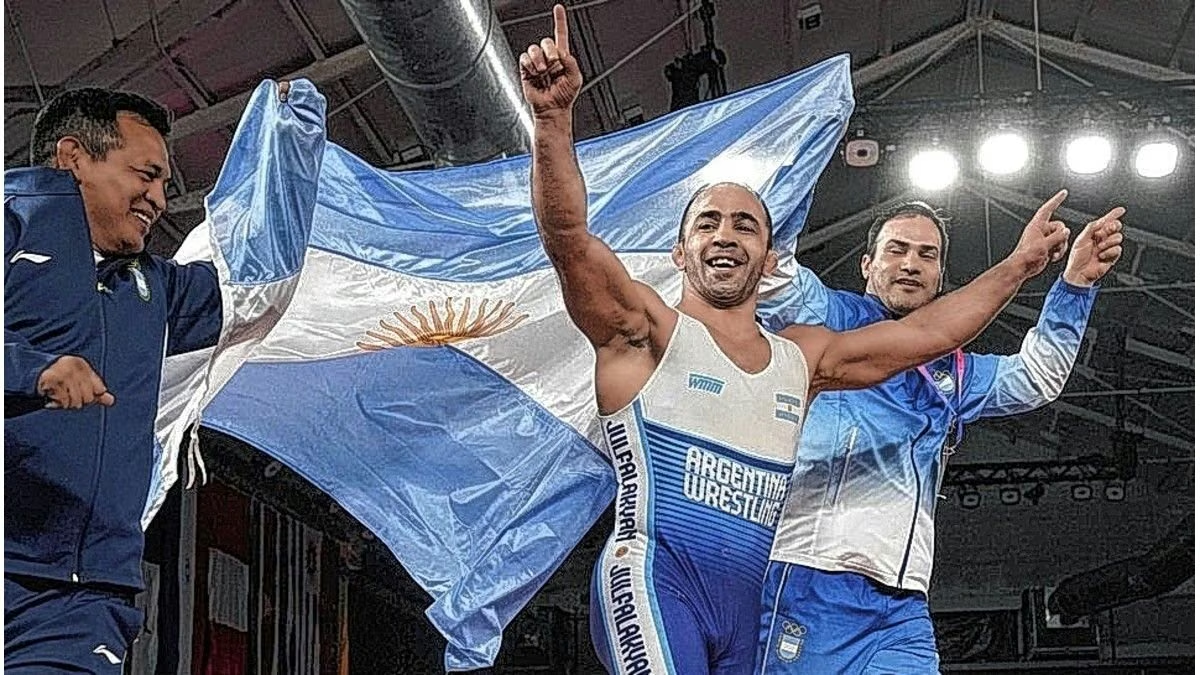
Arsen Julfalakyan added an unexpected chapter to an extraordinary career by winning Argentina a Greco-Roman wrestling gold medal at the Santa Fe 2026 South American Games. At 39, the Armenian-born athlete defeated Colombia’s Jair Cuero 4-2 in the 77kg final at Hall B of La Rural in Rosario. The victory brought two flags together within a competitive journey that has now extended across more than two decades.
Precision matters when describing his stature: Arsen was not an Olympic champion, but the silver medallist at London 2012 and a world champion in 2014. Olympic gold belongs to his father, Levon Julfalakyan, the Seoul 1988 winner who later spent years as Armenia’s national head coach. Arsen grew up around wrestling, although he has explained that his father never forced him to continue the family path. He began formal training at eleven.
Born on May 8, 1987 in Leninakan, the Armenian city now known as Gyumri, he constructed one of the most consistent records of his generation. He became European champion in Vilnius in 2009, took world silver in 2010, bronze in 2011 and 2013, and the world title in Tashkent in 2014. At London he reached the Olympic 74kg final, where Russia’s Roman Vlasov denied him the gold his father had earned 24 years earlier.
His next Olympic cycle ended differently. Julfalakyan lost 3-2 to Bulgaria’s Daniel Aleksandrov in the opening round at Rio 2016. He still added a European bronze in 2019 and pursued another Games appearance, but a controversial defeat against compatriot Karapet Chalyan influenced the federation’s decision to prepare another representative for Tokyo. Julfalakyan announced his retirement on July 12, 2021, though that farewell ultimately proved temporary.
Away from elite competition, he also built an institutional career. He studied International Relations at Yerevan State University, served in Armenia’s National Assembly from 2018 to 2020 and became chair of the United World Wrestling Athletes’ Commission. That journey reveals a figure who understands wrestling through training, competition and sports governance, and who chose to wear the singlet again when his years as an active athlete appeared finished.
The comeback arrived in 2024 at France’s Henri Deglane Grand Prix with a crucial change: Julfalakyan began competing under Argentina’s flag. Armenia already had Malkhas Amoyan, the reigning European and world champion, in his category, limiting any route back into his native country’s team. The Argentine option opened a fresh competitive chapter and eventually took him to Rosario as a married father still capable of challenging for an international title.
The 4-2 win over Jair Cuero transformed that second sporting life into gold for the home delegation. Julfalakyan did not need to erase his Armenian past to represent Argentina; his story connects Levon’s legacy, Olympic silver, a world title, retirement and return. Santa Fe 2026 supplied a powerful new image: an experienced champion celebrating in Argentine colours on a local mat and showing that a career can discover another purpose after it seems complete.